
Tuesday, September 29, 2009


Friday, September 25, 2009
Car Free Sunday in Amsterdam
Car Free Sunday was surprisingly not so car free in Amsterdam. Sure there were a ton of activities celebrating the myriad modes of alternative transportation, but there were also a lot of "bio" cars showcased throughout the city. I participated in a parade sponsored by the Fietsersbond that was half bikes and half cars powered by non petroleum based fuels.  To be fair, I think the day was also designated as "clean air day," but it was nonetheless ironic to ride a bicycle next to cars in a car free day parade.
I eventually peeled off from the parade to join up with the fixed gear guys and gals to spend the afternoon playing bicycle polo. Some fellows from Arnhem, Netherlands brought a proper polo court and we had a 4 or 5 hour tournament. One of them made this nice little video showcasing the tournament and car free day:
Because my team lost in the first round and never got to play again, I had plenty of time to make a few pictures at the tournament. I was, however, flattered when later in the tournament I was asked to stand in for one of the oldest bike messengers in the city (Fish). Our team lost again, but hey, bike polo aint easy.
 The proper court in all of its glory.
  Metal Madness. The Bad Brains were playing quite a bit this afternoon, interspersed with some Dr. Dre and Snoop Dogg from time to time for good measure. Ah, it felt almost like home: punk rock and gangsta rap!
  Lester is picture in the foreground here with the blue disc wheel. The man can play some polo, yall. He also has a frame building internship at RIH, a local framebuilding company here in Amsterdam. This in addition to his responsibilities as a bicycle messenger with Infinity Express.
  Marc from Amsterdamize on a fixed gear. Who would have thought this day would come? At least he doesn't own the bike. In fact, I think he rode it just for the publicity.
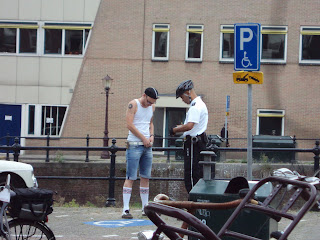 This fellow, from Arnhem, was ticketed for taking a leak in the canal. Happens to the best of us, I suppose.
 South African James gettin' some play.
 Sipe, whose arm is pictured here, later went to the hospital for the injuries he sustained on this fateful afternoon.
 Packing up the polo court at day's end.
***************************************************************************
After the polo tournament, we headed to the Pristine Fixed Gear Shop to take a look at some pictures made of the fixie kids.
Here are a couple of note (mostly because I'm in them ;):
 This is a picture of a picture, but you can still see me to the right, glancing down at who knows what. It was gettin' kinda crazy by this point....
 This was my fierce look. To my right is an Australian fellow, while behind me is Fish, a really nice guy and a pretty famous European messenger. Fish has worked in major cities across the world delivering stuff on his bike.
And finally, the picture you've all been waiting for:
 Last night, after polo, we headed to the Centuirbaan Squat. The squat has a give away store (GAS), and this was what happened when we started digging through the piles.
Among my finer moments, I do say.
 To be fair, I think the day was also designated as "clean air day," but it was nonetheless ironic to ride a bicycle next to cars in a car free day parade.
I eventually peeled off from the parade to join up with the fixed gear guys and gals to spend the afternoon playing bicycle polo. Some fellows from Arnhem, Netherlands brought a proper polo court and we had a 4 or 5 hour tournament. One of them made this nice little video showcasing the tournament and car free day:
Car Free Sunday in Amsterdam. from cavin on Vimeo.
Because my team lost in the first round and never got to play again, I had plenty of time to make a few pictures at the tournament. I was, however, flattered when later in the tournament I was asked to stand in for one of the oldest bike messengers in the city (Fish). Our team lost again, but hey, bike polo aint easy.
 The proper court in all of its glory.
  Metal Madness. The Bad Brains were playing quite a bit this afternoon, interspersed with some Dr. Dre and Snoop Dogg from time to time for good measure. Ah, it felt almost like home: punk rock and gangsta rap!
  Lester is picture in the foreground here with the blue disc wheel. The man can play some polo, yall. He also has a frame building internship at RIH, a local framebuilding company here in Amsterdam. This in addition to his responsibilities as a bicycle messenger with Infinity Express.
  Marc from Amsterdamize on a fixed gear. Who would have thought this day would come? At least he doesn't own the bike. In fact, I think he rode it just for the publicity.
 This fellow, from Arnhem, was ticketed for taking a leak in the canal. Happens to the best of us, I suppose.
 South African James gettin' some play.
 Sipe, whose arm is pictured here, later went to the hospital for the injuries he sustained on this fateful afternoon.
 Packing up the polo court at day's end.
***************************************************************************
After the polo tournament, we headed to the Pristine Fixed Gear Shop to take a look at some pictures made of the fixie kids.
Here are a couple of note (mostly because I'm in them ;):
 This is a picture of a picture, but you can still see me to the right, glancing down at who knows what. It was gettin' kinda crazy by this point....
 This was my fierce look. To my right is an Australian fellow, while behind me is Fish, a really nice guy and a pretty famous European messenger. Fish has worked in major cities across the world delivering stuff on his bike.
And finally, the picture you've all been waiting for:
 Last night, after polo, we headed to the Centuirbaan Squat. The squat has a give away store (GAS), and this was what happened when we started digging through the piles.
Among my finer moments, I do say.
Saturday, September 19, 2009
Bicycle Cultures?
The narrowing eyes; the furrowed brow; "Bicycle Cultures" they say, as if tasting the two words together for the first time.
For most people, though, it is during a conversation with me that they first use the two words "bicycle" and "culture" together as a concrete concept.
"I'm studying bicycle cultures," I tell them. "Interesting," they reply. "So are you writing a thesis or something? It's like an academic thing through university?"
No....not exactly. "I'm on a fellowship, not a scholarship; so there isn't any piece of scholarly work that results from the trip. Really, the trip is more about participating in bicycle cultures that 'studying' them," I say.
Approving nods and something to the effect of "well, that's perfect!" usually follows.
"So how do you study bicycle cultures?" asked a good friend yesterday.
I hope this post might shed a bit of light on both what I'm doing and how I'm doing it....
My work is probably best described as equal parts "best practice research," "solo bicycle adventuring," and "constant networking" with individuals within bicycle communities.
The best practices part is pretty straightforward: I make appointments with bicycle advocates, as I've done in Copenhagen and Amsterdam; I talk with folks in the municipality about the history and current state of affairs regarding bicycle policy; I take photos and observe infrastructure; I read official policy documents, accounts of the bicycle culture from local observers, and I talk to people in parks and on the road about their perceptions of "the bicycle."
I really try to zone in on what is important to bicyclists in the place I'm living to get a good sense of how well the bike culture has developed.
A good example of one of these "local issues" would be bicycle parking. In both Copenhagen and Amsterdam, the municipalities are trying hard to increase the number of bike parking spots while continuing to improve bike parking facilities so as to keep bikes secure and close to the rider's destination. They take this stuff seriously. I have a 150 page manual I received from the Danish Cycling Federation (DCF) about bicycle parking, and the content is just as you might guess. Page after page of information about what works and what sucks when it comes to bike parking. The book was so sought after by municipalities around the world they had to publish it in English a couple years ago.
Speaking of the DCF:
 The Danish Cycling Federation has been an active force in shaping bicycle policy and road development in Denmark since 1905. They facilitated the protest movement during the oil crisis of the early 1970s which led to an increase in bicycle tracks and dedicated bicycle infrastructure in Copenhagen. The national and local bicycle routes across Denmark are signed, mapped and maintained with the help of the DCF.
In the Netherlands,
 you have the Fietsersbond, or the Dutch National Cycling Union with more than 130 branches and 33,000 members nationwide. Nationwide, by the way, means an expanse of land about twice the size of New Jersey containing approximately 16 million people. The Amsterdam branch has two paid employees and a crew of volunteers from a variety of neighborhoods across the city. These neighborhood volunteers report to the Fietsersbond any problems they see with current bicycle facilities, and the Fietsersbond lobbies the municipality to promote improvements.
The union has maintained excellent relations with the municipality since 1975, the year the Union was created, and the city continues to turn to the Fietsersbond as it expands and maintains the most bicycle friendly city in the Western world.
Solo bicycle adventuring is a wonderful way to see a country inside and out, to explore it's culture in a thoroughgoing manner. It is also a particularly nice way to gauge the bicycle friendly status of a nation. Much has been said so far about solo touring in previous posts, so take a scroll back through or see it all for the first time!
Networking within the bicycle community is perhaps the most important and the most gratifying part of my work. It is also, at times, the most difficult.
 This group of guys is hard at work installing the floors at the soon to be "Pristine Fixed Gear" bike boutique. We hung out on this Friday morning and did some construction work, though we usually do more fun stuff like play bike polo. Soon, I hope to stage a flat track attack similar to the ones Cort in Memphis hosted last summer.
 These are my friends from Copenhagen gathered at the Baisikeli shop three days before I left. We were out celebrating the annual "Nansensgade Festival," a yearly street party held on the road where Baiskeli runs a shop.
Networking with the bike community is hard for one obvious reasons: some people take their time warming up to a traveling stranger. A less obvious difficulty, however, is the actual process involved in finding the bike people...A process that involves maps, foreign names for "bicycle," and a lot of small talk.
I often think it's easier to understand bicycle culture through images, as thousands of bicycles locked up at the Amsterdam Centraal Station is usually enough to inspire within the average person a pretty concrete image of bicycle cultures. So here are just a few samplings of the kinds of images in a bike culture that inspire me:


 It should also be said that a big piece of my work is attempting to understand the ways in which individuals are banded together into a community by the bicycle. These pictures, then, stop short of capturing the best part of my trip: making friends and finding my community amongst people who love the bicycle and recognize it's potential.
Finally, there are others attempting to define and describe "bicycle cultures." Most notably are two blogs, Copenhagenize.com and Amsterdamize.com. Mikael and Marc respectively have spent many hundreds of hours laboring over videos, photographs and articles in an effort to define and articulate the many dimensions of bicycle cultures.
Wikipedia has a pretty decent entry on bike cultures, though it is good because I suspect it was created by our friend Mikael.
What do you think a bike culture is? How do you recgonize it? How can you define it? I'm not an anthropologist, so don't come at me with anything too academic! I'm not looking to qualify bicycle culture so much as be able to point at something and say pretty definitively, "that's it!"
All gentle musings are welcome!
For most people, though, it is during a conversation with me that they first use the two words "bicycle" and "culture" together as a concrete concept.
"I'm studying bicycle cultures," I tell them. "Interesting," they reply. "So are you writing a thesis or something? It's like an academic thing through university?"
No....not exactly. "I'm on a fellowship, not a scholarship; so there isn't any piece of scholarly work that results from the trip. Really, the trip is more about participating in bicycle cultures that 'studying' them," I say.
Approving nods and something to the effect of "well, that's perfect!" usually follows.
"So how do you study bicycle cultures?" asked a good friend yesterday.
I hope this post might shed a bit of light on both what I'm doing and how I'm doing it....
My work is probably best described as equal parts "best practice research," "solo bicycle adventuring," and "constant networking" with individuals within bicycle communities.
The best practices part is pretty straightforward: I make appointments with bicycle advocates, as I've done in Copenhagen and Amsterdam; I talk with folks in the municipality about the history and current state of affairs regarding bicycle policy; I take photos and observe infrastructure; I read official policy documents, accounts of the bicycle culture from local observers, and I talk to people in parks and on the road about their perceptions of "the bicycle."
I really try to zone in on what is important to bicyclists in the place I'm living to get a good sense of how well the bike culture has developed.
A good example of one of these "local issues" would be bicycle parking. In both Copenhagen and Amsterdam, the municipalities are trying hard to increase the number of bike parking spots while continuing to improve bike parking facilities so as to keep bikes secure and close to the rider's destination. They take this stuff seriously. I have a 150 page manual I received from the Danish Cycling Federation (DCF) about bicycle parking, and the content is just as you might guess. Page after page of information about what works and what sucks when it comes to bike parking. The book was so sought after by municipalities around the world they had to publish it in English a couple years ago.
Speaking of the DCF:
The Danish Cycling Federation has been an active force in shaping bicycle policy and road development in Denmark since 1905. They facilitated the protest movement during the oil crisis of the early 1970s which led to an increase in bicycle tracks and dedicated bicycle infrastructure in Copenhagen. The national and local bicycle routes across Denmark are signed, mapped and maintained with the help of the DCF.In the Netherlands,
 you have the Fietsersbond, or the Dutch National Cycling Union with more than 130 branches and 33,000 members nationwide. Nationwide, by the way, means an expanse of land about twice the size of New Jersey containing approximately 16 million people. The Amsterdam branch has two paid employees and a crew of volunteers from a variety of neighborhoods across the city. These neighborhood volunteers report to the Fietsersbond any problems they see with current bicycle facilities, and the Fietsersbond lobbies the municipality to promote improvements.
The union has maintained excellent relations with the municipality since 1975, the year the Union was created, and the city continues to turn to the Fietsersbond as it expands and maintains the most bicycle friendly city in the Western world.
Solo bicycle adventuring is a wonderful way to see a country inside and out, to explore it's culture in a thoroughgoing manner. It is also a particularly nice way to gauge the bicycle friendly status of a nation. Much has been said so far about solo touring in previous posts, so take a scroll back through or see it all for the first time!
Networking within the bicycle community is perhaps the most important and the most gratifying part of my work. It is also, at times, the most difficult.
 This group of guys is hard at work installing the floors at the soon to be "Pristine Fixed Gear" bike boutique. We hung out on this Friday morning and did some construction work, though we usually do more fun stuff like play bike polo. Soon, I hope to stage a flat track attack similar to the ones Cort in Memphis hosted last summer.
 These are my friends from Copenhagen gathered at the Baisikeli shop three days before I left. We were out celebrating the annual "Nansensgade Festival," a yearly street party held on the road where Baiskeli runs a shop.
Networking with the bike community is hard for one obvious reasons: some people take their time warming up to a traveling stranger. A less obvious difficulty, however, is the actual process involved in finding the bike people...A process that involves maps, foreign names for "bicycle," and a lot of small talk.
I often think it's easier to understand bicycle culture through images, as thousands of bicycles locked up at the Amsterdam Centraal Station is usually enough to inspire within the average person a pretty concrete image of bicycle cultures. So here are just a few samplings of the kinds of images in a bike culture that inspire me:


 It should also be said that a big piece of my work is attempting to understand the ways in which individuals are banded together into a community by the bicycle. These pictures, then, stop short of capturing the best part of my trip: making friends and finding my community amongst people who love the bicycle and recognize it's potential.
Finally, there are others attempting to define and describe "bicycle cultures." Most notably are two blogs, Copenhagenize.com and Amsterdamize.com. Mikael and Marc respectively have spent many hundreds of hours laboring over videos, photographs and articles in an effort to define and articulate the many dimensions of bicycle cultures.
Wikipedia has a pretty decent entry on bike cultures, though it is good because I suspect it was created by our friend Mikael.
What do you think a bike culture is? How do you recgonize it? How can you define it? I'm not an anthropologist, so don't come at me with anything too academic! I'm not looking to qualify bicycle culture so much as be able to point at something and say pretty definitively, "that's it!"
All gentle musings are welcome!
Wednesday, September 16, 2009
Notes on Fear
For those of you following this blog and living in and around Memphis, Tennessee U.S.A., take note of the following passage:
"Fear of cycling is most effectively produced through constructions of cycling as a dangerous practice. By saying that cycling is constructed as a dangerous practice, I am not denying that cyclists are really injured and killed on the roads; rather I am noting how people’s fears of these (im)probabilities of injury and death are culturally constructed."
(Dave Horton, http://www.copenhagenize.com/2009/09/fear-of-cycling-02-constructing-fear-of.html, 2009)
It's important to recognize that when a few cyclists are killed in Memphis by cars amongst a very small overall pool of riders, accidents will seem quite common.
But when the same amount of deaths occur in a place where you have a ton of bicycle riders, while those deaths continue to shock and humble, they also tend to appear as statistical anomalies.
Simply put, the same number of people crash in a city where you have 400,000 commuters using the bike each day as when you have 1,000 people riding their bicycle. It's just that, with the 400,000 riders you have a lot smaller statistical likelihood of crashing.
And you have a boatload of bicycle on the road each day.
So I agree with the above passage: fear is indeed a culturally prescribed inhibitor for would be bicycle riders. I rode my bicycle for over 10 years as a daily commuter in the "mean" streets of Memphis without having a single major crash (aside from something that was my own fault rather than a car's fault!). I never bought a motor vehicle, and I rode the bike pretty much everywhere.
So does that make me a super hero?
No more than the kid who can eat 48 hot dogs in one sitting.
Riding a bicycle is not a super human act. It is a simple act, a humble gesture of kindness to the world and to oneself. And it's pretty easy. Have you heard how heavy the Dutch bikes are?
Have you ever looked up how much power a human's leg is capable of producing?
Of all things, don't let fear hold you back from riding the bike. Once you start, you won't regret it. And you might not stop.
"Fear of cycling is most effectively produced through constructions of cycling as a dangerous practice. By saying that cycling is constructed as a dangerous practice, I am not denying that cyclists are really injured and killed on the roads; rather I am noting how people’s fears of these (im)probabilities of injury and death are culturally constructed."
(Dave Horton, http://www.copenhagenize.com/2009/09/fear-of-cycling-02-constructing-fear-of.html, 2009)
It's important to recognize that when a few cyclists are killed in Memphis by cars amongst a very small overall pool of riders, accidents will seem quite common.
But when the same amount of deaths occur in a place where you have a ton of bicycle riders, while those deaths continue to shock and humble, they also tend to appear as statistical anomalies.
Simply put, the same number of people crash in a city where you have 400,000 commuters using the bike each day as when you have 1,000 people riding their bicycle. It's just that, with the 400,000 riders you have a lot smaller statistical likelihood of crashing.
And you have a boatload of bicycle on the road each day.
So I agree with the above passage: fear is indeed a culturally prescribed inhibitor for would be bicycle riders. I rode my bicycle for over 10 years as a daily commuter in the "mean" streets of Memphis without having a single major crash (aside from something that was my own fault rather than a car's fault!). I never bought a motor vehicle, and I rode the bike pretty much everywhere.
So does that make me a super hero?
No more than the kid who can eat 48 hot dogs in one sitting.
Riding a bicycle is not a super human act. It is a simple act, a humble gesture of kindness to the world and to oneself. And it's pretty easy. Have you heard how heavy the Dutch bikes are?
Have you ever looked up how much power a human's leg is capable of producing?
Of all things, don't let fear hold you back from riding the bike. Once you start, you won't regret it. And you might not stop.
Thursday, September 10, 2009
Notes on Bicycle Advocacy
For some weeks now, I've wanted to make a post with some general observations about the differences between bicycle advocacy where I come from and the the places that I'm traveling through.
Be warned, though: this is not a thoroughly researched, well documented article about the history of bicycle advocacy in America or Europe. Rather, these are a few limited observations made during more than two months spent studying bicycle cultures in Europe.
1. Staying Positive:
Most of the advocacy I have seen in Denmark and the Netherlands has been oriented at *increasing* the positive benefits across the social spectrum which are accrued from more bicycling. One simple example is a statistic from Denmark which the Danish Cycling Federation put together: for every kilometer bicycled in Denmark, the government actually earns one Danish Crown. This is a particularly poignant political argument for fiscal conservatives as it demonstrates the returns on bicycle investment. Sure it costs money to create bicycle infrastructure; in today's world, it costs money to do almost anything! But the returns on bicycle investments are quite good.
2. Name the Goal, not the Step.
I actually read this in a zine I picked up while haunting a local squat here in Amsterdam. It was a zine about computer technology, of all things, but I think it is a good way of positing a solution to a common problem with bicycle advocates. Installing new bike parking is not the goal, it is the step. An increase in bicycle lanes is not the goal, it is the step. A healthier society is the goal. A city that can move its people with increased efficiency and care, that is the goal. The goal, I think, can compel and inspire people to get out on a bike, which is more powerful than arguments for increased spending on blue stripes in the roadway. For effective advocates, the work before us goes beyond the bicycle, and it should be clearly stated that bike advocates are about more than increasing the number of people on bicycles.
I think this point chafes the sensibilities of bicycle enthusiasts because for so many of us, the bicycle in itself is a powerful tool for social and personal liberation. But the time for preaching to the choir has come and gone. Reaching more people requires broadening the message.
3. Eco-guilt and Slim Bodies Won't Cut it
What is the number one reason people bicycle in Denmark? Ease and convenience. In the Netherlands? 7.2 of 10 people say they are satisfied with the network of bicycle tracks throughout the city. This is a pretty good satisfaction rate for bicycle infrastructure.
A well developed, easy to use system of designated paths is critical to making cycling attractive. Public health, eco friendliness and sustainability, I would argue, are the by-products of bicycle cultures built around convenience. This is a point that should not be lost, because providing convenient and efficient transportation to a municipality's citizenry is in many ways as important as providing fire and ambulance services. Vehicular mobility often determines social mobility, and cities with limited vehicular mobility are often cities with limited social mobility as well. Bicycle paths, then, can be seen as a noble service provided to citizens.
4. America Lacks not for Best Practices; We Lack Political Will
The culture wars, I would argue, are one of the reasons bicycling has enjoyed little progress in America. I think advocates and cyclists alike often fail to use the bicycle as a political tool to bridge the divide between social conservatism and social liberalism. I've observed many of the most passionate bicycle lovers are bent on destroying the car culture in the U.S.; or bent on shoveling out the old guard of traffic engineers in favor of newer, hipper, more enlightened engineers.
Let's get real. The car culture will change in coming years, for sure, but the goal of bicycle advocates should not be to promote its demise. The same is true with the field of traffic engineering.
To focus on the ways in which the bicycle is a unifying force, the ways in which it acts as an egalitarian tool to increase the opportunity for all peoples is, to me, a much more politically sensible approach to effective advocacy. As long as an "us (bikes) vs. them (cars and the engineers/politicians/companies that promote them!)" mentality pervades bicycle advocacy, our single speed wheels will continue to spin and want for political traction.
Me? I'm hoping to encourage the car companies--perhaps in an effort to win some nice publicity for a change--to start a small grants program aimed at increasing effective bicycle advocacy. Refreshing but impossible, you say? Keep an open mind. You'd be amazed at what is possible.
So let's discuss. What, in your estimation, has led to the bicycle's trivial role in American society. This list is not exhaustive, and it certainly needs some improvement.
Weigh in!
Be warned, though: this is not a thoroughly researched, well documented article about the history of bicycle advocacy in America or Europe. Rather, these are a few limited observations made during more than two months spent studying bicycle cultures in Europe.
1. Staying Positive:
Most of the advocacy I have seen in Denmark and the Netherlands has been oriented at *increasing* the positive benefits across the social spectrum which are accrued from more bicycling. One simple example is a statistic from Denmark which the Danish Cycling Federation put together: for every kilometer bicycled in Denmark, the government actually earns one Danish Crown. This is a particularly poignant political argument for fiscal conservatives as it demonstrates the returns on bicycle investment. Sure it costs money to create bicycle infrastructure; in today's world, it costs money to do almost anything! But the returns on bicycle investments are quite good.
2. Name the Goal, not the Step.
I actually read this in a zine I picked up while haunting a local squat here in Amsterdam. It was a zine about computer technology, of all things, but I think it is a good way of positing a solution to a common problem with bicycle advocates. Installing new bike parking is not the goal, it is the step. An increase in bicycle lanes is not the goal, it is the step. A healthier society is the goal. A city that can move its people with increased efficiency and care, that is the goal. The goal, I think, can compel and inspire people to get out on a bike, which is more powerful than arguments for increased spending on blue stripes in the roadway. For effective advocates, the work before us goes beyond the bicycle, and it should be clearly stated that bike advocates are about more than increasing the number of people on bicycles.
I think this point chafes the sensibilities of bicycle enthusiasts because for so many of us, the bicycle in itself is a powerful tool for social and personal liberation. But the time for preaching to the choir has come and gone. Reaching more people requires broadening the message.
3. Eco-guilt and Slim Bodies Won't Cut it
What is the number one reason people bicycle in Denmark? Ease and convenience. In the Netherlands? 7.2 of 10 people say they are satisfied with the network of bicycle tracks throughout the city. This is a pretty good satisfaction rate for bicycle infrastructure.
A well developed, easy to use system of designated paths is critical to making cycling attractive. Public health, eco friendliness and sustainability, I would argue, are the by-products of bicycle cultures built around convenience. This is a point that should not be lost, because providing convenient and efficient transportation to a municipality's citizenry is in many ways as important as providing fire and ambulance services. Vehicular mobility often determines social mobility, and cities with limited vehicular mobility are often cities with limited social mobility as well. Bicycle paths, then, can be seen as a noble service provided to citizens.
4. America Lacks not for Best Practices; We Lack Political Will
The culture wars, I would argue, are one of the reasons bicycling has enjoyed little progress in America. I think advocates and cyclists alike often fail to use the bicycle as a political tool to bridge the divide between social conservatism and social liberalism. I've observed many of the most passionate bicycle lovers are bent on destroying the car culture in the U.S.; or bent on shoveling out the old guard of traffic engineers in favor of newer, hipper, more enlightened engineers.
Let's get real. The car culture will change in coming years, for sure, but the goal of bicycle advocates should not be to promote its demise. The same is true with the field of traffic engineering.
To focus on the ways in which the bicycle is a unifying force, the ways in which it acts as an egalitarian tool to increase the opportunity for all peoples is, to me, a much more politically sensible approach to effective advocacy. As long as an "us (bikes) vs. them (cars and the engineers/politicians/companies that promote them!)" mentality pervades bicycle advocacy, our single speed wheels will continue to spin and want for political traction.
Me? I'm hoping to encourage the car companies--perhaps in an effort to win some nice publicity for a change--to start a small grants program aimed at increasing effective bicycle advocacy. Refreshing but impossible, you say? Keep an open mind. You'd be amazed at what is possible.
So let's discuss. What, in your estimation, has led to the bicycle's trivial role in American society. This list is not exhaustive, and it certainly needs some improvement.
Weigh in!
Wednesday, September 9, 2009
Bicycle Speed Bumps?
Have you ever seen a bicycle speed bump around your town?
 I hadn't either. In fact, it honestly never occurred to me that one would ever need a bicycle speed bump. But lo and behold, here in Amsterdam they've got them.
This one was placed in front of a school house, so I'm guessing they installed the traffic calming device on this bike-only path to decrease the pedestrian/bicycle crashes.
The collisions between children and all kinds of traffic--including bicycles--has steadily improved in the Netherlands.
"Over the past decades, road safety has improved more for children than for the rest of the population. In the mid-1980s, the number of fatalities among children was approximately 120 and in recent years it has been approximately 35."
(source: SWOV Fact sheet © SWOV, Leidschendam, the Netherlands, February 2009)
Horray for the bicycle speed bumps! Not only are they increasing the safety of school children, they are actually kind of fun to ride. Unlike car speed bumps, the bike bumps have a wavering bump that feels a bit like a roller coaster. Safety and fun for the price of one.
 I hadn't either. In fact, it honestly never occurred to me that one would ever need a bicycle speed bump. But lo and behold, here in Amsterdam they've got them.
This one was placed in front of a school house, so I'm guessing they installed the traffic calming device on this bike-only path to decrease the pedestrian/bicycle crashes.
The collisions between children and all kinds of traffic--including bicycles--has steadily improved in the Netherlands.
"Over the past decades, road safety has improved more for children than for the rest of the population. In the mid-1980s, the number of fatalities among children was approximately 120 and in recent years it has been approximately 35."
(source: SWOV Fact sheet © SWOV, Leidschendam, the Netherlands, February 2009)
Horray for the bicycle speed bumps! Not only are they increasing the safety of school children, they are actually kind of fun to ride. Unlike car speed bumps, the bike bumps have a wavering bump that feels a bit like a roller coaster. Safety and fun for the price of one.
Saturday, September 5, 2009
The City
Amsterdam is simply a majestic city. Like Copenhagen, the city is more than 800 years old. It grew up around a port on the River Ij, which is located just north of the Centraal Station.
 Even since I was here in 2006, the station area has improved dramatically. Long known as a hotspot for seedy characters and a bastion for raucous, the station now teems with people on a mission. Its bursting with the hustle and bustle of people with intentions rather than the sketchy stagnancy of aimlessness. For what its worth, the city appears to have taken steps to make the whole centrum a bit more controlled. Politzei can be seen casually strolling in and around the red light district just beside the station, a scene of control amidst a culture that in some ways promotes indulgence.
The road to Amsterdam was a long one; probably around 1800 Kilometers. I didn't have a computer, and honestly, I was a bit too tired each night to calculate my mileage. But while the road was long, it was amazing.
 Once I was in the Netherlands, these very helpful red signs pointed the way at every major intersection. I had a map, but it turned out to be little more than a confirmation for the signs. The routes throughout the Netherlands are incredibly well signed, and it's possible to take a bike path to almost every city and town across the country.
 When I neared Amsterdam, I found myself on an off-road single track path, a pretty common feature of touring in Europe.
 I think this picture is poignant, as sometimes life is like having a double wide trailer on a single track trail. In other words it's not always easy to move forward, but it is always possible. Sometimes it just requires a bit more effort.
I finally saw the sign I'd been waiting for since I left Copenhagen just outside the city:
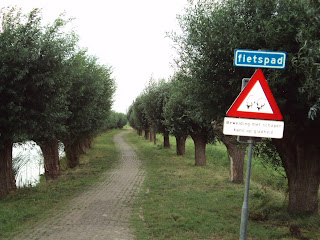 My Dutch isn't so good, but I'm almost positive that this sign says watch for wandering sheep. I think this means I have officially arrived in the most bicycle friendly place in the Western world: They make the effort to warn cyclists of hazardous sheep.
Less than 10k outside of Amsterdam, I came upon a German couple bent over a bicycle lying on the ground. I asked if all was okay, and they responded with troubled looks and a clear "nay," things were not okay. Upon further inspection, the lady had crashed her bike into the barrier preventing cars from entering the bike path; she had bent the bicycle frame and fork in the crash restricting the handlebar movement. After a bit of grunting and pulling, we bent the frame back into place (sorta...) and the handlebars were free to turn again. Joyfully, the gentleman passed along his card and asked for a photo:
 He offered his home to me anytime, a house just outside Nuremberg, Germany. We both left a bit happier than before I arrived.
 The path into the city was smooth and wide open; though I arrived without a place to stay, despite having searched like mad, I found a great campground just north of the center. Tired but satisfied I set up my tent and began my travels throughout the city.
 The first thing I noticed after beginning my walk through the city was that my shoes were probably the most tired object in my traveling cache. I think these photos tell the story:
 I bought a pair of blue high top "chucks" at the local flea market and left these on the sidewalk just where they lay. A big piece of my trip is about learning how and when to let go. For these, my favorite slip-on Vans, the time had come to let go.
I've made some great contacts in the city already; bike polo, alleycats, cargo bike shops, racing shops, BMX/Freestyle shops, community bike programs; More bike culture than I know what to do with. I reckon I'll find a way to fit it all in.
This was the final picture of the tour:
View The tour from CPH to AMS in a larger map
 Even since I was here in 2006, the station area has improved dramatically. Long known as a hotspot for seedy characters and a bastion for raucous, the station now teems with people on a mission. Its bursting with the hustle and bustle of people with intentions rather than the sketchy stagnancy of aimlessness. For what its worth, the city appears to have taken steps to make the whole centrum a bit more controlled. Politzei can be seen casually strolling in and around the red light district just beside the station, a scene of control amidst a culture that in some ways promotes indulgence.
The road to Amsterdam was a long one; probably around 1800 Kilometers.
 I didn't have a computer, and honestly, I was a bit too tired each night to calculate my mileage. But while the road was long, it was amazing.
 Once I was in the Netherlands, these very helpful red signs pointed the way at every major intersection. I had a map, but it turned out to be little more than a confirmation for the signs. The routes throughout the Netherlands are incredibly well signed, and it's possible to take a bike path to almost every city and town across the country.
 When I neared Amsterdam, I found myself on an off-road single track path, a pretty common feature of touring in Europe.
 I think this picture is poignant, as sometimes life is like having a double wide trailer on a single track trail. In other words it's not always easy to move forward, but it is always possible. Sometimes it just requires a bit more effort.
I finally saw the sign I'd been waiting for since I left Copenhagen just outside the city:
 My Dutch isn't so good, but I'm almost positive that this sign says watch for wandering sheep. I think this means I have officially arrived in the most bicycle friendly place in the Western world: They make the effort to warn cyclists of hazardous sheep.
Less than 10k outside of Amsterdam, I came upon a German couple bent over a bicycle lying on the ground. I asked if all was okay, and they responded with troubled looks and a clear "nay," things were not okay. Upon further inspection, the lady had crashed her bike into the barrier preventing cars from entering the bike path; she had bent the bicycle frame and fork in the crash restricting the handlebar movement. After a bit of grunting and pulling, we bent the frame back into place (sorta...) and the handlebars were free to turn again. Joyfully, the gentleman passed along his card and asked for a photo:
 He offered his home to me anytime, a house just outside Nuremberg, Germany. We both left a bit happier than before I arrived.
 The path into the city was smooth and wide open; though I arrived without a place to stay, despite having searched like mad, I found a great campground just north of the center. Tired but satisfied I set up my tent and began my travels throughout the city.
 The first thing I noticed after beginning my walk through the city was that my shoes were probably the most tired object in my traveling cache. I think these photos tell the story:
 I bought a pair of blue high top "chucks" at the local flea market and left these on the sidewalk just where they lay. A big piece of my trip is about learning how and when to let go. For these, my favorite slip-on Vans, the time had come to let go.
I've made some great contacts in the city already; bike polo, alleycats, cargo bike shops, racing shops, BMX/Freestyle shops, community bike programs; More bike culture than I know what to do with. I reckon I'll find a way to fit it all in.
This was the final picture of the tour:
View The tour from CPH to AMS in a larger map
Thursday, September 3, 2009
Amsterdam
I've arrived safely in Amsterdam after spending many kilometers on the bicycle traversing Western Europe. Unfortunately (or fortunately--depending on your perspective), all I have to show for it at the moment is this huge ice cream cone:
 I enjoyed this coffee, strawberry, chocolate ice cream cone in a little village called Hooghallen in the north of the Netherlands. One of my favorite parts of the trips so far has been stopping in at small bakeries tucked away in even smaller hamlets across the Netherlands.
Now, the big city awaits. Tonight there is a "fixed gear meeting" at the local fixie shop, Pristine Fixed Gear. They advertise their bike polo as accessible for all people, regardless of fixed gear experience or knowledge. Sounds like a welcome change from Copenhagen!
Stay tuned for a full report on the tour...
 I enjoyed this coffee, strawberry, chocolate ice cream cone in a little village called Hooghallen in the north of the Netherlands. One of my favorite parts of the trips so far has been stopping in at small bakeries tucked away in even smaller hamlets across the Netherlands.
Now, the big city awaits. Tonight there is a "fixed gear meeting" at the local fixie shop, Pristine Fixed Gear. They advertise their bike polo as accessible for all people, regardless of fixed gear experience or knowledge. Sounds like a welcome change from Copenhagen!
Stay tuned for a full report on the tour...
Sunday, August 30, 2009
The Netherlands
So I've made it to the place most people agree on as the Western world's capital for bicycling: The Netherlands.
After days of dodging thunderstorms and overcoming headwinds (14 days, to be exact) I've just crossed the border from Germany. I'm in a small town just west of the border called Winschoten at a nice little campground complete with wireless internet! The town contains about a half dozen churches alongside another half dozen windmills. And because it is Sunday in Europe, you all know what is happening: absolutely nothing.
 I took this (overexposed) picture of myself just before I left my camping place in Germany two days ago. I'll try for a better one soon enough. The camping places in Germany were fantastic: they all had a breakfast option (usually bread and cheese) and they each served beer at the check in desk. I have to say, one of the best things about the tour so far has been rolling into a campsite after 100 kilometers, paying 6 Euro to sleep for a night, and enjoying an icy cold German beverage.
 I've seen a lot of cows and pigs and horses on the tour, smelled them mostly, but I also saw this disorderly herd of older folks clamoring about in the center of the bike track. Clamoring or not, how often do you see 30 or more senior citizens rolling down a bicycle path? It was a first for me.
This cat was lying perfectly still in the center of the road for literally an hour before I hunkered down to photograph it. Then it came straight for me, intent on being loved. Just a random tidbit of my world for you.
2 days to Amsterdam. Boy am I excited. For now, enjoy a few fun facts about the Netherlands from the 2009 Bicycle Report which you can find at the European Cycling Federation's Website.
After days of dodging thunderstorms and overcoming headwinds (14 days, to be exact) I've just crossed the border from Germany. I'm in a small town just west of the border called Winschoten at a nice little campground complete with wireless internet! The town contains about a half dozen churches alongside another half dozen windmills. And because it is Sunday in Europe, you all know what is happening: absolutely nothing.
 I took this (overexposed) picture of myself just before I left my camping place in Germany two days ago. I'll try for a better one soon enough. The camping places in Germany were fantastic: they all had a breakfast option (usually bread and cheese) and they each served beer at the check in desk. I have to say, one of the best things about the tour so far has been rolling into a campsite after 100 kilometers, paying 6 Euro to sleep for a night, and enjoying an icy cold German beverage.
 I've seen a lot of cows and pigs and horses on the tour, smelled them mostly, but I also saw this disorderly herd of older folks clamoring about in the center of the bike track. Clamoring or not, how often do you see 30 or more senior citizens rolling down a bicycle path? It was a first for me.
 This cat was lying perfectly still in the center of the road for literally an hour before I hunkered down to photograph it. Then it came straight for me, intent on being loved. Just a random tidbit of my world for you.
2 days to Amsterdam. Boy am I excited. For now, enjoy a few fun facts about the Netherlands from the 2009 Bicycle Report which you can find at the European Cycling Federation's Website.
- The Netherlands is the only European nation that has more bicycles than it has people (18 million bikes, 16 million people.)
- An interesting note about safety: (Directly from the text) "Something that should not be overlooked...Liabilty. In some countries, bicycling is seen as causing danger, which sometimes ends up in anti-cycling policy. The Dutch philosophy is: cyclists are not dangerous; cars and car drivers are. So car drivers should take responsibilty for avoiding collisions with cyclists. This implies that car drivers are almost always liable when a collision with a bicycle occurs and should adapt their speed when they share the road with cyclists." (p. 14)
- The Netherlands has the highest number of people bicycling of any European country, but they also have the lowest fatality rate per kilometer bicycled. More bikes always means more safety.
Wednesday, August 26, 2009
The Tour Across Denmark
Being that I had never done a bicycle tour alone, I was a bit nervous about leaving Copenhagen headed for the Netherlands with a heavy trailer packed to the gills with my life for a year.
Still and all, away I went. Into the, well, into the sheep.
 There were sheep crowding the path out of town. I suppose sheep are friendly enough creatures, but I would have hoped that the most bicycle friendly city in the world might have posted a "watch for sheep" sign. Sadly, I was left to my own best devices to contend with the sheep.
 I rode down the coast most of the way south. This was a fairly typical picture for me during my tour of Denmark. Lots of ocean, which means....you guessed it...lots of wind.
 The first night, I camped next to a high-schoolish thing. There were loads of kids running around into the wee hours having fun. I camped in a free spot, one of hundreds across the country that Denmark has created and preserved. They usually come with a shelter and a saw to cut firewood. The above picture is a shot from my tent where, just beside me, a German couple camped peacefully. The German man looked quite a bit like Harry Potter.
I passed through a mid-sized town (by Danish standards) called Vordinburg on my way to the islands south of Zealand. These are the largest castle ruins outside of the small island of Bornholm.
 At the top of the castle is a golden goose, which was intended to taunt potential invaders.
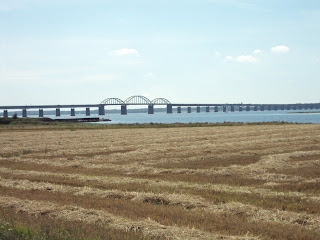
 I crossed over from Zealand to the island of Halster on this bridge. A bridge complete with a bicycle lane; imagine that. Don't let them get the renovation of the I-55 bridge done without including a bicycle path!
 It's super easy to tour by bicycle in Denmark because the route is filled with signs directing you the right way. Still, I bought a compass just in case.
I camped on the tip of Halster the second night before taking the ferry across to Fyn. I ended up in a very small harbor, Tars Havn, where I met a man that made windmill wings. The harbormaster didn't speak any English, so when he came to collect my money he jokingly referred to himself as "No-English Man." It was like he was a super hero! Well, the campsite was super anyway, and I caught this shot before bed.

 When the trailer is un-packed, it's a bit amazing how much spills out. At the end of the day I often feel like my hometown of Memphis--like I'm sprawling out of control!
The next morning I woke up bright and early to catch the ferry. The sailors tied my bike to the boat so it didn't fall over. I was greatly appreciative.
 I arrived in Odense at the end of the third day, tired and ready for a shower. Odense was slow. There were quite a few "cute" pieces of bicycle infrastructure--like bicycle emblems built into the cobblestone in light colored stones--but nothing especially interesting. I tried to get air for my tires at one of the many pumps they keep around the city, but alas, it didn't work. Odense may get a bit short-changed in this post.
After leaving Odense, I traveled to Jutland and towards Germany. I met 6 amazing Germans at a remote, free camping spot positioned directly beside the ocean on my first night outside of Odense.

 We stayed up quite late having adult beverages and talking. They were taking a break from the big cities--like Copenhagen--cause they were running out of money. When its free to camp, and the shelter is provided, a quick trip to the nearby town every now and again to grab supplies is all you need to make a very nice vacation spot. Cheers to my new German friends!
So this is the path so far, from Copenhagen to my current location in Flensburg, Germany.
View Copenhagen to Flensburg in a larger map
Next stop: Amsterdam, the Netherlands.
Still and all, away I went. Into the, well, into the sheep.
 There were sheep crowding the path out of town. I suppose sheep are friendly enough creatures, but I would have hoped that the most bicycle friendly city in the world might have posted a "watch for sheep" sign. Sadly, I was left to my own best devices to contend with the sheep.
 I rode down the coast most of the way south. This was a fairly typical picture for me during my tour of Denmark. Lots of ocean, which means....you guessed it...lots of wind.
 The first night, I camped next to a high-schoolish thing. There were loads of kids running around into the wee hours having fun. I camped in a free spot, one of hundreds across the country that Denmark has created and preserved. They usually come with a shelter and a saw to cut firewood. The above picture is a shot from my tent where, just beside me, a German couple camped peacefully. The German man looked quite a bit like Harry Potter.
I passed through a mid-sized town (by Danish standards) called Vordinburg on my way to the islands south of Zealand. These are the largest castle ruins outside of the small island of Bornholm.
 At the top of the castle is a golden goose, which was intended to taunt potential invaders.
 I crossed over from Zealand to the island of Halster on this bridge. A bridge complete with a bicycle lane; imagine that. Don't let them get the renovation of the I-55 bridge done without including a bicycle path!
 It's super easy to tour by bicycle in Denmark because the route is filled with signs directing you the right way. Still, I bought a compass just in case.
I camped on the tip of Halster the second night before taking the ferry across to Fyn. I ended up in a very small harbor, Tars Havn, where I met a man that made windmill wings. The harbormaster didn't speak any English, so when he came to collect my money he jokingly referred to himself as "No-English Man." It was like he was a super hero! Well, the campsite was super anyway, and I caught this shot before bed.

 When the trailer is un-packed, it's a bit amazing how much spills out. At the end of the day I often feel like my hometown of Memphis--like I'm sprawling out of control!
The next morning I woke up bright and early to catch the ferry. The sailors tied my bike to the boat so it didn't fall over. I was greatly appreciative.
 I arrived in Odense at the end of the third day, tired and ready for a shower. Odense was slow. There were quite a few "cute" pieces of bicycle infrastructure--like bicycle emblems built into the cobblestone in light colored stones--but nothing especially interesting. I tried to get air for my tires at one of the many pumps they keep around the city, but alas, it didn't work. Odense may get a bit short-changed in this post.
After leaving Odense, I traveled to Jutland and towards Germany. I met 6 amazing Germans at a remote, free camping spot positioned directly beside the ocean on my first night outside of Odense.

 We stayed up quite late having adult beverages and talking. They were taking a break from the big cities--like Copenhagen--cause they were running out of money. When its free to camp, and the shelter is provided, a quick trip to the nearby town every now and again to grab supplies is all you need to make a very nice vacation spot. Cheers to my new German friends!
So this is the path so far, from Copenhagen to my current location in Flensburg, Germany.
View Copenhagen to Flensburg in a larger map
Next stop: Amsterdam, the Netherlands.
Subscribe to:
Posts (Atom)